

Our Very Own Gestora
Itzel Vilches on finding printmaking, honoring her border roots, and growing as both an artist and arts manager.

As we kick off Women’s History Month and celebrate our third season, Gestoras is excited to launch a new Substack series spotlighting Latine and Latin American women-identifying artists from the past to the present, across both the Global North and South.
We’re beginning close to home by featuring our very own team member, Itzel Vilches. Born and raised on the Texas border, Itzel is a multimedia artist whose work centers on border identity, bilingualism, and heritage. She earned her BFA in Printmaking from the University of Texas at San Antonio in 2021.
In this week’s post, team member Karina sits down with Itzel to discuss her creative process, the nuances of border identity, and how she balances life as both an artist and an arts manager. Read below to learn more about Itzel’s work and practice.
Karina: Thank you so much for joining me for this conversation. To begin, a question that must always be asked: What kickstarted your artistic journey?
Itzel: I was definitely always an artistic kid. Ever since I was little, the most exciting part of getting new school journals was drawing on them. I always had that interest, but I never really had the formal education or resources to explore art beyond my own creativity. It was always just my own interest in drawing, painting, and being creative. When I moved to the United States at nine, I suddenly had access to art clubs, school events, and creative opportunities that hadn’t been available to me before. Here, I was able to foster that talent further. By middle school, I was entering art contests, something I never had the chance to do while living in Mexico. In seventh grade, I won my first art competition, and when my teacher called my mom, she said, “Itzel won.” That was a big moment for me — thinking to myself, “Am I good at this?” And that’s really when it started to click: “Oh, my thing is art.” This is my lane. This is what I’m going to keep following through high school. So I kept cultivating those skills through Art Club and classes.
But I did not really have many friends who were artists, and I really didn’t have relatives who were artists. So, seeing artists in my community wasn’t very common until I went to college and discovered a group of people making the same art forms I was. I finally got to embrace that creative spirit and explore it through education in the U.S.
Karina: I actually want to follow up on your artistic disciplines. You’ve mentioned having an interest in drawing, painting, and other visual art media. However, much of your current work and passion is printmaking. When did it really become about printmaking along your art journey?
Itzel: It actually came to be quite late, and I will always be so frustrated about it: not knowing this thing existed. For a long time, I wondered what my art form would be. Two years had passed in my college education, and I still had no idea printmaking existed. I had never stepped foot in a studio until I went to UTSA (University of Texas San Antonio) to finish my degree. I was just exploring the art building when I walked into the biggest printmaking studio I had ever seen. There was a huge wall of windows, a gorgeous tree outside, prints covering the walls, presses everywhere, inks laid out. I thought, “Oh my God, I’ve arrived. This is what I’m supposed to do.”
In that moment, everything connected. So much of my interest in art history and art in general had always centered around printmakers. I had never realized I had such a keen interest in history because I loved looking at the pictures. All of those pictures were etchings and lithographs. I hadn’t connected the dots. When I was interested in Mexican history and the Revolution, I was looking at linocuts and woodcuts. It literally all fell together. I remember thinking, “I cannot believe I hadn’t tied this thread together sooner.” All the art I had loved, all the eras I was drawn to, were connected by printmaking. I also had never understood printmaking to be so diverse. It felt like if I chose this concentration, I would still have so much variety and so many directions to explore.
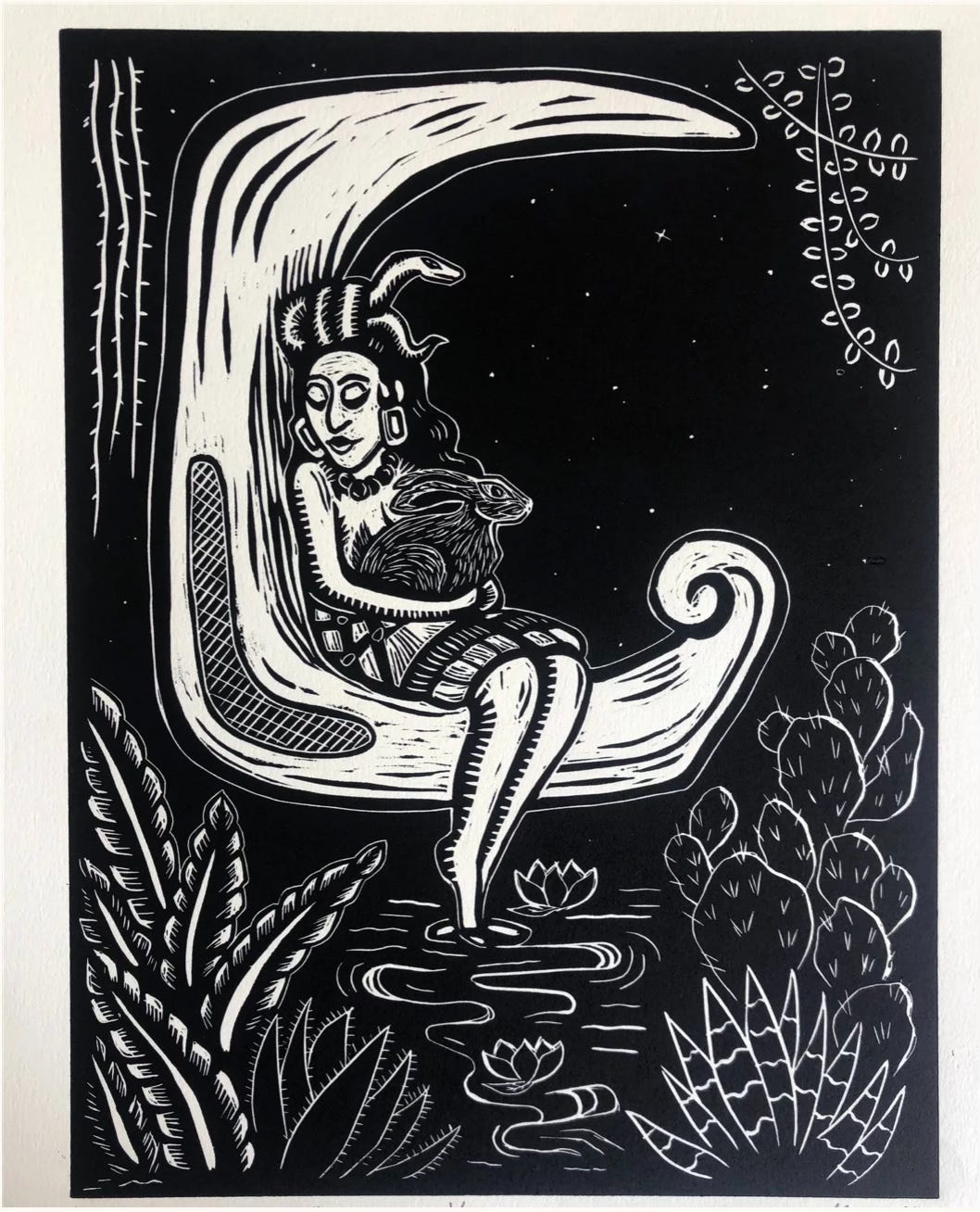
La Historia de Ixchel, Relief Print, 8x10 in, 2019. https://www.itzelvilchesart.com/portfolio/la-historia-de-ixchel
Had I discovered it earlier, or had I been at UTSA for the full four years of my undergraduate, I would have loved to have spent more time there. And then, of course, as I was finishing the degree, the pandemic hit, so I had to go home. My time, my precious time, was cut short in that room. But in a strange way, it also pushed me to build a printmaking practice at home.
Karina: How different really is it to do printmaking in the studio versus at home?
Itzel: When I graduated in 2022, I did a virtual residency, and before that, I had nothing but the supplies I bought for class. It was really just me, with a fold-out table, a glass palette, wooden spoons, and the inks in the living room of a three-person apartment. During that residency, I was able to buy my first press. Two years later, I received a grant that allowed me to build a printmaking station in my room using my woodworking skills. That desk is still with me after three moves across the country.
Karina: Moving on from the art process to the art itself. You mentioned growing up in Mexico for your early childhood and moving to Texas. A lot of your works really translate border culture and you, yourself crossing it. Did your art start that way, or was it a transition into seeing the need to share your identity through art?
Itzel: There definitely was an “Ah ha!” moment, and it was my friends who helped me realize it. When I was younger, I was always making work just because I wanted to be creative, not because I felt like I had something to say yet. I felt too young and too inexperienced and I didn’t recognize the story I was holding. Later, in college, my friends asked me, “You have this story of border identity that we’re all subject to. Why aren’t you making work about that?” And it was like a light bulb went off.
Once I started diving into that story of border identity, the rest of the work came. I was really excited to explore topics like the identity crises you face living on the border and the duality of things. But also, just celebrating the culture that we had. Growing up, there wasn’t a lot of pride about being from the border. There wasn’t much recognition for the things that made us unique. Once I started making work and saw others around me celebrating our uniqueness and contributions, I realized, “Oh, here’s our identity.” Rather than being dangerous and crime-ridden, border towns are unique, especially Laredo.
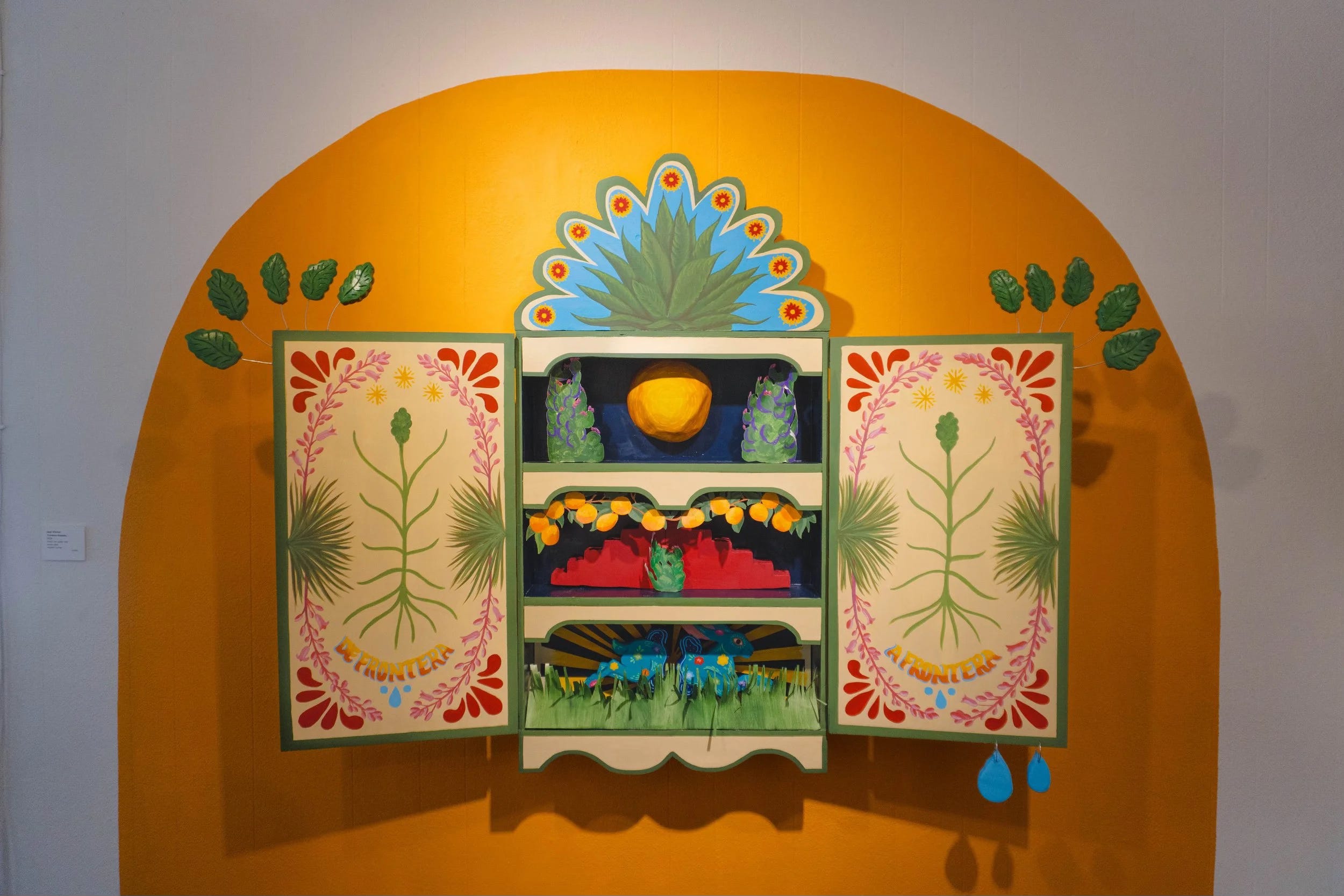
Frontera Retablo, 2024. https://www.itzelvilchesart.com/portfolio/frontera-retablo
Karina: After graduating, you also worked at the San Antonio Museum of Art as an educator. How were you juggling being an artist while also teaching art through an institutional machine like the San Antonio Museum of Art?
Itzel: That position was really fun. I grew so much from it, and I realized what I wanted from my exposure to art institutions. There are no art museums in Laredo, so I had very minimal exposure to art institutions. I wanted to have a career and do something with art, not only struggle as an artist. While I had taught art to kids before, teaching adults felt powerful. I loved that I was doing it in a predominantly Hispanic community and that I could connect with guests because I was bilingual. That was really important to me.
It was also meaningful that I was an artist first. I was able to apply not only technical skills and creative insight, but also the organizational mindset that comes with planning activities and events. It was about logistical coordination and ensuring people had meaningful art experiences. That challenge was something I genuinely loved.
Karina: The last question I have is more future-driven: Are there any projects you’ve had on the back burner that you want to revisit? Or are there any projects that you’ve already completed that you would love to expand?
Itzel: One project I keep thinking about revisiting is the series I created for my 2024 solo show, Como Se Dice. It was a printmaking series centered on Spanglish words, and there are still so many I haven’t even touched on. There is so much potential for that series to continue, so I would love to have a Volume 2 with 6 new prints. But also, there are things I haven’t done as an artist that I want to delve into. Over the past year, I’ve been interested in painting, so I would love to create more. With the topics I have in mind and the conversations I want to tackle in the work, some prints can be part of a show as well. But ultimately, it’s about time and having the capacity to create work at the scale I envision.
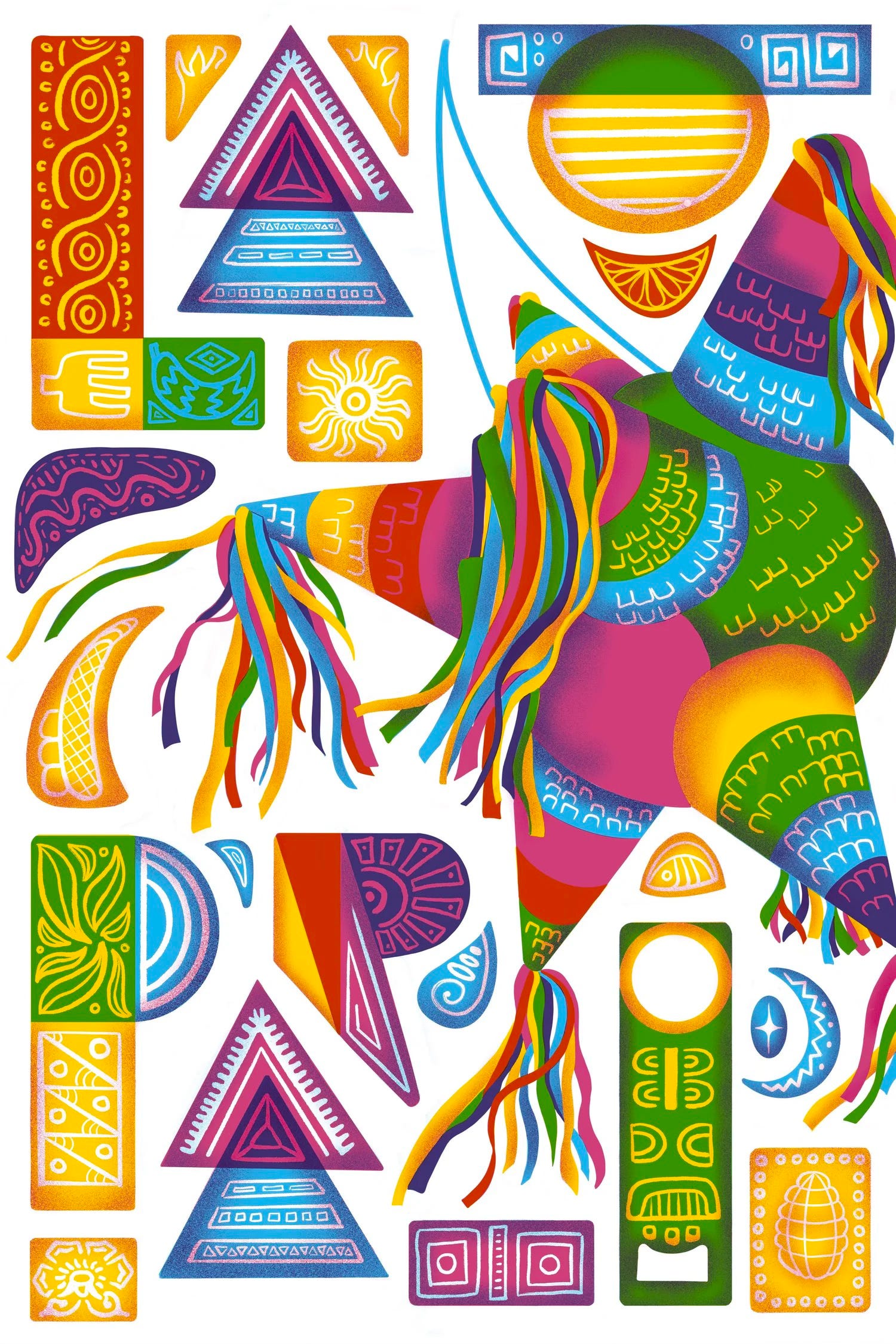
La Pari, 20in x 28in, 2024. https://www.itzelvilchesart.com/portfolio/como-se-dice-series
Thank you for joining us for this conversation with Gestoras team member and incredible artist, Itzel Vilches. To learn more about her work and explore her full portfolio, visit her website at itzelvilchesart.com.
Be sure to follow along on our Substack and Instagram as we continue this series, highlighting Latine and Latin American women-identifying artists from the past to the present!